Can a 3,600mAh Portable Fan Be Taken on a Plane?
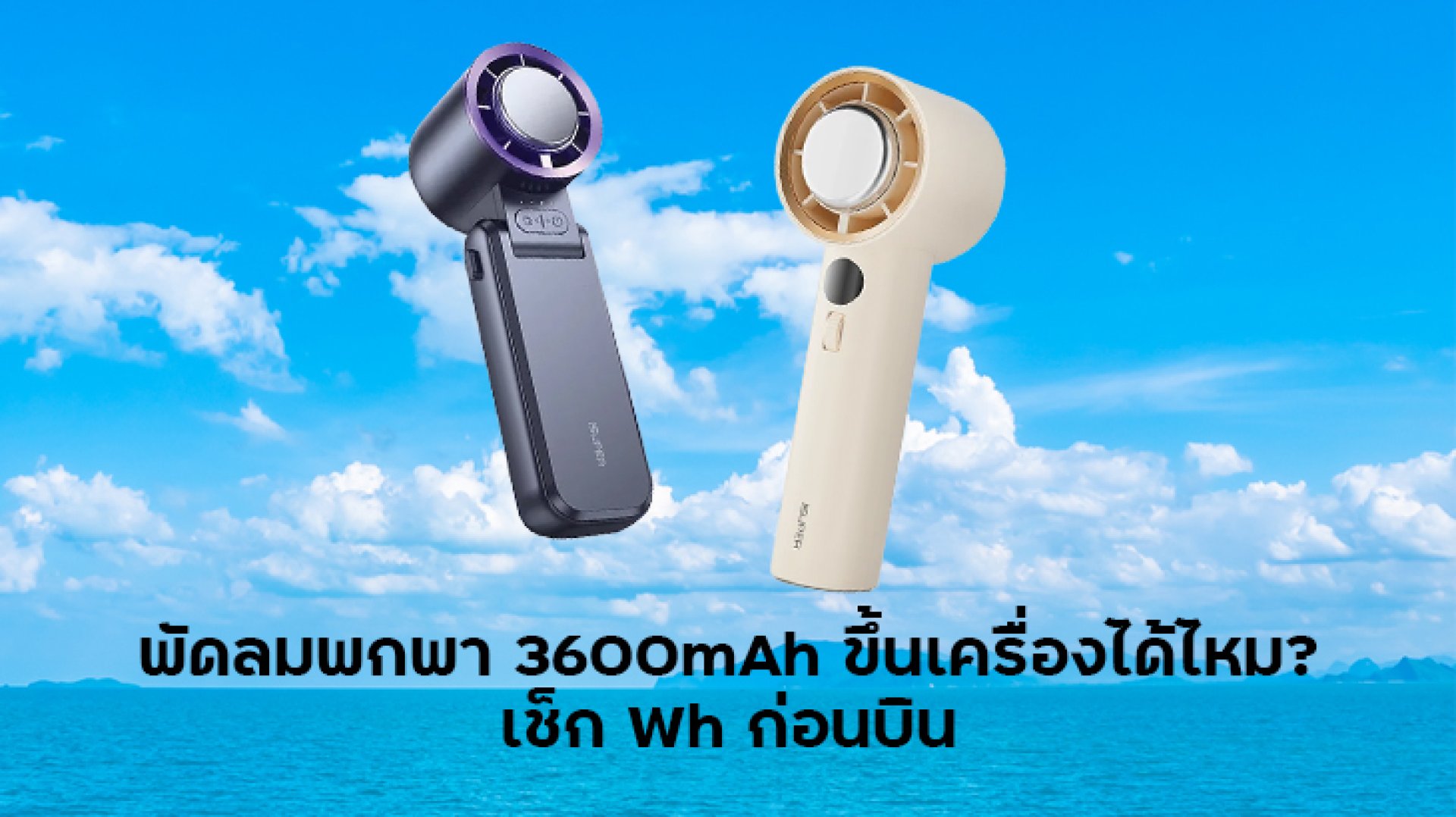
Can a 3,600mAh portable fan be taken on a plane? This is a common question among travelers who use cordless handheld fans, neck fans, or rechargeable portable fans. If your fan has a built-in lithium battery, you may wonder whether you can bring it into the cabin or whether it needs to be placed in checked baggage.
The good news is that a 3,600mAh portable fan can generally be carried when traveling by air, provided that the battery and device comply with the airline's requirements. However, you should not look at the mAh rating alone.
For air travel, the battery's energy capacity is generally evaluated in Watt-hours (Wh). This means you need to consider both the battery capacity in mAh and its voltage.
For example, a 3,600mAh battery rated at 3.7V would have approximately 13.32Wh of energy. This is well below the commonly referenced 100Wh threshold for lithium-ion batteries, although airline-specific rules should always be checked before your trip.
Can a 3,600mAh Portable Fan Be Taken on a Plane?
In general, a portable fan with a 3,600mAh lithium-ion battery can be taken on a plane, provided that the device and battery meet the requirements of the airline and applicable aviation regulations.
However, the number 3,600mAh alone does not determine whether the battery is permitted. You also need to know the battery voltage and calculate its Watt-hour rating.
This is important because two batteries with the same mAh rating can have different energy capacities if their voltage ratings are different.
Before flying, check the battery specification printed on the product, packaging, or manufacturer's documentation, and confirm the latest requirements with your airline.
How Many Wh Is a 3,600mAh Battery?
Most portable fans are advertised using mAh (milliamp-hours), which describes the battery's charge capacity. However, airline battery regulations commonly use Wh (Watt-hours) to describe the amount of energy stored in a battery.
The basic conversion formula is:
Wh = (mAh × V) ÷ 1,000
For example, if a portable fan has a 3,600mAh battery with a nominal voltage of 3.7V:
Wh = (3,600 × 3.7) ÷ 1,000 = 13.32Wh
Therefore, the example battery stores approximately 13.32Wh of energy.
Keep in mind that you should use the actual battery voltage specified by the manufacturer. Do not assume that every 3,600mAh battery has the same Wh rating.
Why Do Airlines Use Wh Instead of mAh?
The reason is simple: mAh alone does not tell you the total amount of energy stored in a battery. You also need to know its voltage.
| Specification | What It Means |
|---|---|
| mAh | Electrical charge capacity |
| V | Electrical voltage |
| Wh | Total battery energy |
This is why a battery's Wh rating is more useful when determining its energy capacity for air-travel purposes.
Can You Put a 3,600mAh Portable Fan in Your Carry-On?
If your portable fan contains a built-in lithium battery, carrying it in your carry-on baggage is generally the preferred option for air travel, subject to the airline's specific rules.
Keeping battery-powered electronic devices in the cabin allows the crew and passengers to respond more quickly if the device develops a problem.
If the fan contains a removable battery, the battery terminals should be protected against short circuits and handled according to the airline's requirements.
Always check your airline's current baggage and lithium battery policy before traveling because airlines may impose additional restrictions.
Can a 3,600mAh Portable Fan Be Put in Checked Baggage?
You should not assume that a portable fan can automatically be placed in checked baggage simply because its battery capacity is below 100Wh.
The rules can differ depending on whether the battery is installed inside the device or is a spare/removable battery. Airlines may also have additional restrictions.
For this reason, carrying a portable fan in your carry-on baggage is often the safer and simpler option, provided that it complies with the airline's requirements.
If you are unsure, contact the airline before departure rather than relying only on the battery's mAh rating.
Can You Use a 3,600mAh Portable Fan During a Flight?
Being allowed to bring a portable fan onto an aircraft does not necessarily mean that you can use it at any time during the flight.
Carry-on approval and in-flight usage are two different issues.
Passengers should follow the instructions of the cabin crew and the airline's onboard safety announcements. During takeoff, landing, or other periods when passengers are instructed to secure electronic devices, the fan may need to be switched off and stored.
If you want to use a portable fan during the flight, wait for the appropriate time and follow the crew's instructions.
What Should You Check Before Taking a 3,600mAh Fan on a Plane?
A few simple checks before leaving home can make your airport experience easier.
- Check the battery capacity in mAh.
- Check the battery voltage in V.
- Check whether the manufacturer provides a Wh rating.
- Keep the product specifications or user manual available.
- Carry the fan in your carry-on baggage when appropriate under the airline's rules.
- Protect removable battery terminals against short circuits.
- Check the airline's latest lithium battery and baggage requirements before departure.
Can the iSUPER Jet Fan 2 and Jet Fan 3 with 3,600mAh Batteries Be Taken on a Plane?
If you are looking for a 3,600mAh portable fan for travel, two examples are the iSUPER Jet Fan 2 and iSUPER Jet Fan 3.
| Specification | iSUPER Jet Fan 2 | iSUPER Jet Fan 3 |
|---|---|---|
| Battery | 3,600mAh | 3,600mAh |
| Voltage | 5V 1A | 5V 1A |
| Power | 10W | 10W |
| Weight | 206g | 250g |
| Wind Speed Levels | 4 levels | 101 levels |
| Maximum Wind Speed | - | Up to 9m/s |
| Motor Speed | - | 13,000 RPM |
| Maximum Runtime | Up to 9 hours* | Up to 11 hours* |
Both models use a 3,600mAh battery, making them relevant examples for people searching for information about taking a 3,600mAh portable fan on a plane.
However, travelers should still verify the battery specifications and the latest airline requirements before flying. Airline policies may vary depending on the type of battery, the device design, and the airline's own safety requirements.
* Maximum runtime is based on the manufacturer's stated testing conditions. Actual runtime can vary depending on wind speed and whether cooling or other functions are enabled.
Is a 3,600mAh Portable Fan Good for Travel?
Battery capacity is only one factor when choosing a portable fan for travel. Weight, size, wind power, battery life, and control options can all affect the overall travel experience.
A compact fan weighing around 200250 grams is generally easier to carry in a backpack or travel bag than a larger, heavier model.
If you expect to spend a lot of time outdoors, having multiple wind-speed settings can also be useful. You can use a lower setting when you only need gentle airflow and increase the speed when you are outdoors in hot weather.
This can help you balance cooling performance and battery runtime depending on the situation.
3,600mAh vs 5,000mAh vs 10,000mAh: Which Is Better for Air Travel?
A higher mAh rating does not automatically mean that a battery is unsuitable for air travel. The actual energy capacity depends on both mAh and voltage.
| Approximate Capacity | Example Voltage | Approximate Energy |
|---|---|---|
| 3,600mAh | 3.7V | 13.32Wh |
| 5,000mAh | 3.7V | 18.50Wh |
| 10,000mAh | 3.7V | 37Wh |
These figures are examples calculated using a 3.7V battery. The actual Wh rating can be different depending on the manufacturer's specified battery voltage.
Final Verdict: Can a 3,600mAh Portable Fan Be Taken on a Plane?
In general, a 3,600mAh portable fan can be taken on a plane, provided that the device and its lithium battery comply with the applicable airline and aviation requirements.
The important point is that you should not judge the battery solely by its 3,600mAh rating. Check the battery's Wh rating, battery type, and the airline's current policy.
For example, a 3,600mAh battery rated at 3.7V has approximately 13.32Wh of energy, which is far below 100Wh.
Before traveling, remember these four points:
- Check Wh, not just mAh.
- Check the type of battery.
- Consider carrying the fan in your carry-on baggage according to airline requirements.
- Check the airline's latest rules before every trip.
For travelers looking for a 3,600mAh portable fan, battery capacity is only part of the decision. Weight, size, wind power, cooling performance, and actual runtime should also be considered when choosing a fan for travel.
FAQ: 3,600mAh Portable Fan on a Plane
Can a 3,600mAh portable fan be taken on a plane?
Generally, yes. A 3,600mAh portable fan can normally be carried when traveling by air, provided that the battery and device comply with the airline's requirements. Check the battery's Wh rating and the airline's latest policy before departure.
How many Wh is a 3,600mAh battery?
It depends on the battery voltage. For example, a 3,600mAh battery rated at 3.7V has approximately 13.32Wh. The formula is Wh = (mAh × V) ÷ 1,000.
Does a 3,600mAh portable fan have to go in carry-on baggage?
Airline requirements vary. For a portable electronic device containing a lithium battery, carry-on baggage is generally the preferred option, but passengers should always follow the specific airline's current requirements.
Can a 3,600mAh portable fan go in checked baggage?
Do not determine this based on mAh alone. The rules can differ depending on whether the lithium battery is installed in the device or is a spare battery. Check the airline's current baggage policy before traveling.
Can a 5,000mAh portable fan be taken on a plane?
It depends on the battery's Wh rating and the airline's requirements. For example, a 5,000mAh battery rated at 3.7V has approximately 18.5Wh.
Can a 10,000mAh portable fan be taken on a plane?
The battery's Wh rating and the airline's requirements must be checked. For example, a 10,000mAh battery rated at 3.7V has approximately 37Wh. Always check the latest airline requirements before traveling.