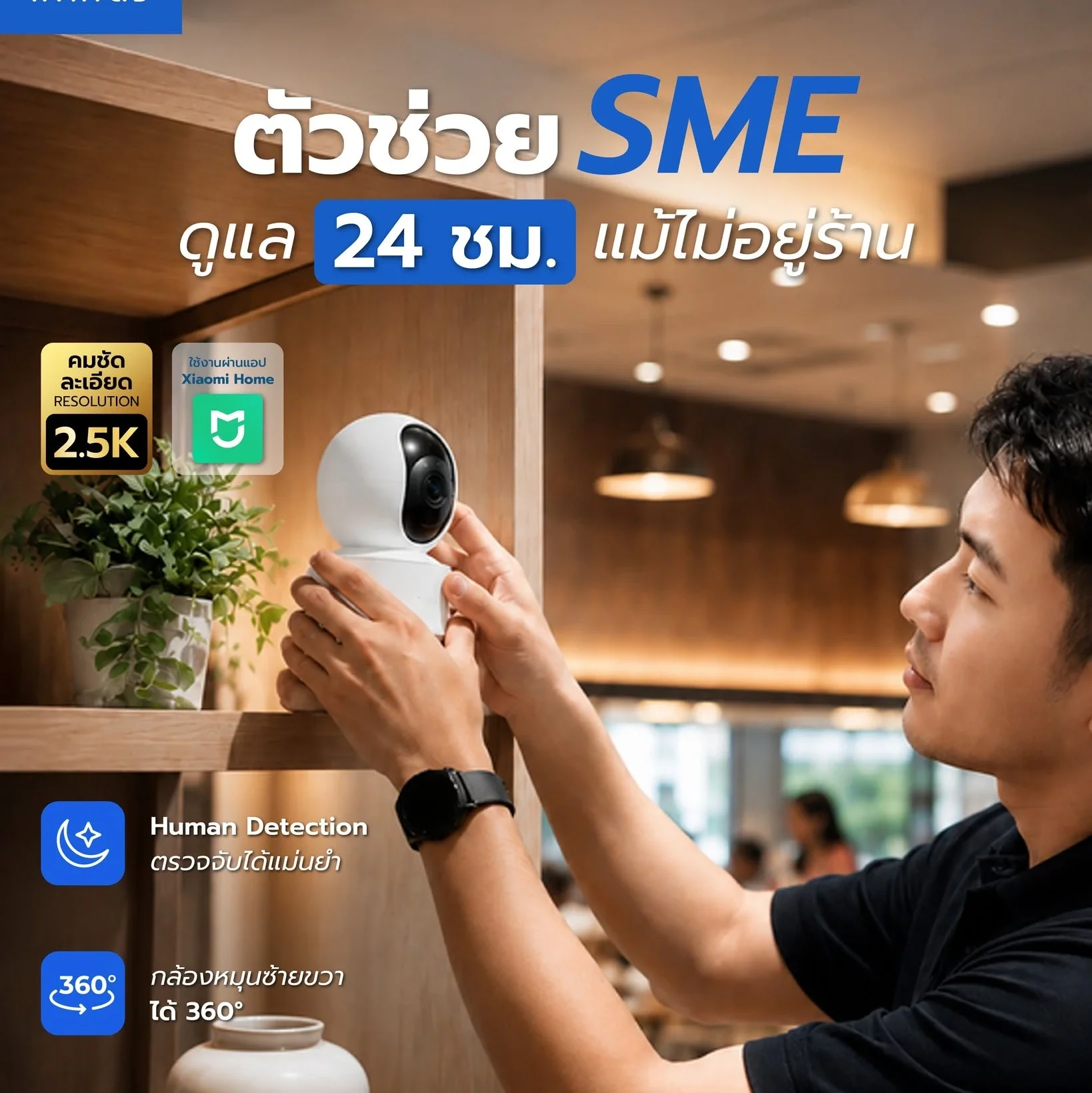
Security Camera
THAI SUPER PHONE
We have CCTV cameras
that can be controlled via smartphone anytime, anywhere,
providing peace of mind 24/7.
And some have AI technology that helps detect objects in specific locations or can provide two-way communication.
Home security is crucial, and having "eyes" watching your home 24/7, like a security camera, is something many households prioritize. We sell two brands of security cameras: IMILAB and Xiaovv, offering a wide range of options. For those on a larger budget and wanting high-quality equipment, we recommend IMILAB. For those seeking a more budget-friendly option, Xiaovv is a good choice. Don't worry about warranties; Xiaovv offers a 1-year warranty, while IMILAB provides a 2-year warranty with easy claims processing through our Thai service center.
Security Camera
We have found 18 items
Sort by


Closed-circuit television (CCTV) cameras are no longer just tools for large organizations or government agencies. They have become an essential part of security for homes, shops, and small businesses. Having these "electronic eyes" to monitor provides peace of mind and crucial evidence in case of unforeseen incidents.
8 Steps to Check Before Buying a CCTV Camera:
Step 1: Ask yourself: What is it for? Where will it be installed?
What is the primary purpose?
General surveillance, monitoring movement (e.g., watching people entering and leaving the house/shop, monitoring pets)
Prevention of intrusion/theft (requires clear images and identifying individuals)
Use as legal evidence (requires very high clarity)
Child/elderly monitoring
Where will it be installed?
Indoor: Living room, office, hallway
Outdoor: Front yard, backyard, garage, fence (must be weather-resistant!)
Area to cover?
Large area (requires wide-angle cameras or multiple cameras)
Specific points (e.g., doorway, cash register – may require zoomable or high-resolution cameras)
Budget?
Step 2: Choose the right camera type for your application.
Dome Camera: Spherical shape, suitable for indoor installation. Visually appealing and blends in well, making lens direction difficult to observe. Provides a degree of protection against vandalism.
Bullet/Turret Camera: Clearly visible camera body, suitable for outdoor installation or where a camera is needed (for deterrence). Often durable and features long-range IR (infrared).
PTZ (Pan-Tilt-Zoom) Camera: Rotatable, tiltable, and zoomable. Suitable for very large areas requiring coverage from a single camera or for target tracking (high price).
Wireless (Wi-Fi) Camera: Easy to install, no LAN cable required. However, ensure the Wi-Fi signal at the installation location is strong and stable! And there must be a power outlet nearby.
Wired Camera (Wired - IP Camera via LAN PoE / Analog via Coax Cable): Most stable, suitable for systems requiring high reliability (especially IP cameras that use a single LAN cable to transmit both image and power - PoE), but installation requires wiring.
Step 3: "The image must be clear" both day and night!
Resolution:
Minimum: Full HD (1080p or 2 million pixels) - Enough to see general details.
Recommended: 2K (approximately 4 million pixels) or higher - Provides sharper images, showing facial details and license plates much better.
Sharpest: 4K (8 million pixels) - For very important points or when you need to zoom in on details without image degradation.
Night Vision:
Infrared Distance (IR Distance): Choose a distance that covers the desired area (e.g., 10-20 meters indoors, 30+ meters outdoors).
Night Image Quality: Must show details, not just shadows. (Look for a good sensor, such as Sony STARVIS)
Color Night Vision: Newer cameras (e.g., ColorVu, Starlight) provide color images even in very low light conditions, allowing for better color identification of clothing and vehicles compared to black and white IR images. (Expertise)
Field of View (FoV): Choose the viewing angle (e.g., 90°, 110°, 180°) that best suits the size of the area.
WDR/HDR: This is crucial for areas with both bright and dark light in the same image (e.g., a camera installed indoors looking out a window). It prevents images from becoming too dark or too bright, obscuring details.
Step 4: How long can the recording system store evidence?
SD Card (in the camera):
Suitable for: 1-2 single cameras, simple operation.
Caution: The card may be stolen/damaged along with the camera; capacity is limited.
Only "High Endurance" cards should be used! (Like those used in car dashcams) because they are constantly overwritten. Check the maximum capacity supported by the camera.
Network Video Recorder (NVR for IP cameras / DVR for Analog cameras):
Suitable for: Systems with multiple cameras, requiring stability, and long-term data storage.
More secure: Data is stored separately from the cameras.
Requires "Surveillance Grade" hard disks only! (e.g., WD Purple, Seagate SkyHawk) Designed for 24/7 operation, calculating capacity to store required historical data (e.g., 7 days, 15 days, 30 days).
Cloud Storage:
Advantages: Secure from recording incidents (data accessible remotely).
Disadvantages: Monthly/annual fees, requires a stable internet connection.
Step
5: "Smart" Optional Features (How much do you need?)
AI Detection (People/Vehicles/Pets): (Very useful!) Filters out unnecessary motion alerts (e.g., rustling leaves, shadows), allowing you to focus only on truly important events.
Two-Way Audio: Allows two-way communication through the camera. (Suitable for communicating with family members, pets, or alerting intruders)
Mobile viewing application (Remote Access App):
Must be easy to use: Simple menu
Stable: Does not disconnect frequently
Full functionality: Live viewing, playback, clip download, convenient settings
Step 6: Durability and Installation
Outdoor Camera:
Waterproof and dustproof: IP66 or IP67 standard
Sun and heat resistant: Choose materials and operating temperature range suitable for Thailand's climate
(Potentially) Vandal resistant: Look for IK rating if installing in a high-risk area
Power supply:
PoE (Power over Ethernet): Most convenient for IP cameras; one LAN cable provides both power and video
Power adapter: Requires a power outlet near the installation location or additional wiring
Step 7: Choose a reliable "brand" and "reliable store/installer"
Brand: Choose a reputable brand, accepted in the market, with regular firmware updates for security, and a warranty and service center in Thailand that can be contacted.
Retailer/Installer: Purchase from a reputable dealer or official store. Beware of grey market, counterfeit, or unqualified shops, as these may have issues with warranty and after-sales service. If you are not capable of self-installation, choose an experienced and trustworthy installer.

 MakeWebEasy