What Is GPS in a Smartwatch? How Does It Work and Do You Need It?
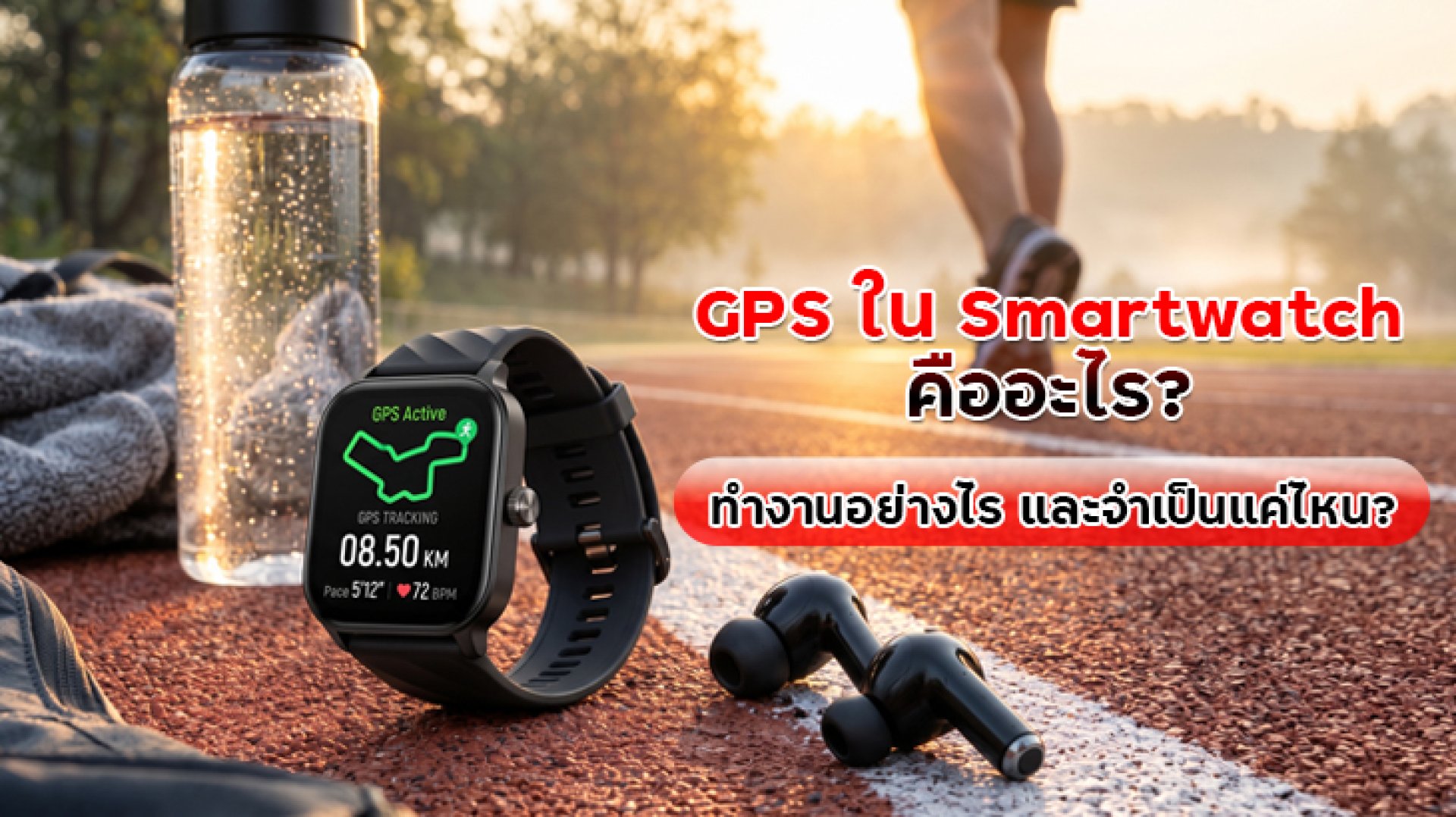
If you're looking for a Smartwatch for running, walking, cycling, or outdoor workouts, GPS is probably one of the specifications you'll see most often. But what does GPS actually do? And if a smartwatch doesn't have built-in GPS, can it still track your location using your smartphone?
Simply put, GPS in a Smartwatch allows the watch to determine where you are and track how you move. This information can then be used to calculate distance, speed, pace, and workout routes without relying only on step counting.
However, not all smartwatch GPS systems perform exactly the same way. The term GPS also doesn't necessarily mean that every smartwatch uses only the GPS satellite system. This guide explains how GPS works, what it can do, how accurate it is, and what to look for when choosing a GPS smartwatch.
What Is GPS in a Smartwatch?
GPS (Global Positioning System) is a satellite-based positioning system. A receiver inside the smartwatch uses signals from multiple satellites to calculate its location.
Once the smartwatch knows its position, it can use that information to calculate or track things such as:
- Distance traveled or distance run
- Speed
- Pace
- Workout routes
- Current location
- Movement direction
- Elevation data on devices that support the required sensors or positioning systems
Garmin explains that GPS receivers can use positioning data to calculate speed, direction, distance, and routes. This is why GPS is an important feature for smartwatches designed for outdoor activities.
How Does GPS in a Smartwatch Work?
The basic principle is simpler than it sounds. The smartwatch receives signals from GPS satellites and uses information from multiple satellites to calculate its position.
The process generally works like this:
- The smartwatch activates its satellite positioning receiver.
- The watch searches for available satellites.
- It receives positioning and timing information from the satellites.
- The watch calculates its location.
- It continuously records position data during the workout.
- The data is used to calculate distance, speed, pace, and the route.
According to GPS.gov, a GPS receiver uses satellite signals to determine three-dimensional position and time. Actual performance depends on factors such as satellite geometry, signal obstruction, and receiver quality.
What Are the Benefits of GPS in a Smartwatch?
1. Track Outdoor Runs More Accurately
When running outdoors, GPS can track your movement and distance based on your actual position. This allows a smartwatch to provide information such as distance and pace rather than relying only on step counting.
For runners, this is particularly useful because knowing how far you've run and what pace you're maintaining can make training easier to monitor.
2. Record Your Workout Route
When GPS records your position during a workout, the data can often be displayed as a route on a map through the companion smartwatch app.
For example, after running 5 kilometers around a park or cycling along a specific route, you can review the recorded path and see where you traveled.
3. Track Speed and Pace
GPS can use changes in position over time to calculate speed and pace. These metrics are particularly useful for running and many other outdoor activities.
However, if GPS reception is poor, distance and pace measurements can also become less accurate.
4. Exercise Outdoors Without Carrying Your Phone
If your smartwatch has built-in GPS, you can often go for a run or walk without carrying your smartphone simply to provide location data.
This is one of the biggest advantages of a smartwatch with built-in GPS for people who want a more convenient outdoor workout experience.
Built-in GPS vs. Smartphone GPS: What's the Difference?
| Feature | Built-in GPS in Smartwatch | GPS from Smartphone |
|---|---|---|
| Need to carry a smartphone | Not necessarily | Usually yes |
| Outdoor route tracking | Tracked directly by the watch | Uses the smartphone's location |
| Freedom of movement | High | Depends on carrying the phone |
| Battery usage | GPS uses smartwatch battery | GPS load is handled by the smartphone |
| Suitable for running | Very suitable | Also suitable if carrying a phone is not a problem |
The exact behavior depends on the smartwatch. Some models have their own GPS receiver, while others can use location data from a paired smartphone.
For example, Apple explains that some Apple Watch models have built-in GPS, while certain older models can use GPS from a nearby iPhone.
Is GPS the Same as GNSS?
These terms are often used interchangeably, but they are not exactly the same.
GPS is the satellite navigation system operated by the United States, while GNSS (Global Navigation Satellite System) is the broader term for satellite-based navigation systems around the world.
Some smartwatches therefore list support for GPS, GLONASS, Galileo, BeiDou, or QZSS. This means the device can use signals from multiple satellite navigation systems.
| System | Country / Region |
|---|---|
| GPS | United States |
| GLONASS | Russia |
| Galileo | European Union |
| BeiDou | China |
| QZSS | Japan and Asia-Pacific region |
So when a smartwatch says it supports Multi-GNSS, it means the device can use data from multiple satellite navigation systems rather than relying exclusively on GPS.
How Accurate Is GPS on a Smartwatch?
The answer is it depends on the watch and the environment. Not every smartwatch provides the same level of GPS accuracy.
GPS.gov explains that GPS accuracy can be affected by several factors, including satellite geometry, signal blockage, atmospheric conditions, and receiver design.
For example, GPS generally performs better in an open area with a clear view of the sky than in a dense urban environment surrounded by tall buildings.
Environments Where GPS Usually Performs Well
- Open parks
- Open roads and running tracks
- Rural areas
- Locations with a clear view of the sky
Environments That Can Reduce GPS Accuracy
- Areas surrounded by tall buildings
- Dense forests
- Indoor locations
- Under bridges
- Areas where satellite signals are blocked or reflected
GPS.gov explains that reflected signals from buildings and other surfaces, known as multipath, can cause errors in the calculated position.
Why Does GPS Sometimes Record Different Distances on the Same Route?
This can happen in real-world use and does not necessarily mean that your smartwatch is defective.
Consumer GPS systems do not produce a perfectly accurate position every second. Each recorded location can contain a small amount of error. When these individual points are connected to create a route, those small errors can affect the total recorded distance.
Garmin refers to one related phenomenon as GPS drift, where the recorded position differs from the actual position. This can affect distance, speed, and pace measurements.
For example, you might run the same 5-kilometer route and see 4.9 km recorded one day and 5.1 km another day. That does not necessarily mean you ran a different route. It can simply be the result of GPS accuracy and environmental conditions.
What Is Dual-Band GPS?
If you start looking at mid-range and high-end smartwatches, you'll often see terms such as Dual-Band GPS or Multi-Band GNSS.
The basic idea is that the receiver can use signals from more than one frequency. This can help the device deal with certain positioning challenges, including signal reflections in urban environments or areas with obstacles.
Garmin states that using multiple frequency bands can improve positioning accuracy and reliability, particularly in environments with trees or buildings.
However, Dual-Band does not mean 100% accuracy. The environment, receiver hardware, antenna design, and software can still affect the final result.
Do You Really Need a Smartwatch With GPS?
It depends more on how you use the watch than how much the watch costs.
| Usage | How Important Is Built-in GPS? |
|---|---|
| Checking the time, notifications, and steps | Not very important |
| Occasional outdoor walking | Useful, but not essential |
| Regular running | Recommended |
| Outdoor cycling | Recommended |
| Trail running or hiking | Very important |
| Tracking routes and pace seriously | Built-in GPS is recommended |
What Should You Look for When Choosing a GPS Smartwatch?
1. Does It Have Built-in GPS?
Don't just look for the words GPS supported. Check whether the smartwatch actually has built-in GPS or whether it relies on GPS from a connected smartphone.
2. Which Satellite Systems Does It Support?
If you frequently exercise outdoors, a smartwatch with Multi-GNSS support can be a useful option because it can use signals from multiple satellite navigation systems.
3. Does It Support Dual-Band GNSS?
If you run in cities, around tall buildings, or in environments where satellite signals are frequently obstructed, Dual-Band or Multi-Band GNSS can be worth considering.
4. How Long Does the Battery Last With GPS?
Don't look only at the smartwatch's overall battery life. Using GPS continuously during workouts consumes additional power.
If you typically run for one or two hours, this may not be a major concern. But for long-distance running, cycling, hiking, or other activities lasting several hours, check the watch's GPS battery life specifically.
5. How Good Is the Companion App?
A good GPS smartwatch isn't only about the GPS receiver. The post-workout experience also matters.
Check whether the companion app provides useful data such as routes, pace, distance, workout history, and training statistics.
Conclusion: Is GPS in a Smartwatch Worth It?
GPS in a Smartwatch is particularly useful for outdoor exercise because it allows the watch to track location, distance, speed, pace, and routes directly.
If you mainly use a smartwatch for checking the time, notifications, step counting, or everyday features, built-in GPS may not be the first feature you need to prioritize.
But if you regularly run, cycle, hike, or want to exercise without carrying your smartphone, a Smartwatch with built-in GPS can make a significant difference.
For people who frequently exercise in cities or areas with tall buildings, choosing a model with Multi-GNSS or Dual-Band GNSS can also be worth considering.
FAQ: GPS in Smartwatches
What does GPS do in a smartwatch?
GPS determines the watch's location and tracks movement. This information can be used to calculate distance, speed, pace, and workout routes during outdoor activities.
Does a smartwatch with GPS need an internet connection?
GPS itself receives signals from satellites and does not necessarily require an internet connection to determine your location. However, features such as online maps, data synchronization, and certain online services may require an internet connection.
Is smartwatch GPS accurate?
Smartwatch GPS is generally accurate enough for everyday use and fitness tracking, but actual accuracy depends on the receiver, environment, signal obstruction, and the positioning technology used by the watch.
What is the difference between GPS and Dual-Band GPS?
GPS is a satellite positioning system, while Dual-Band means the receiver can use signals on more than one frequency. This can improve positioning accuracy and reliability in environments with obstacles or reflected signals.
Can I run with a smartwatch that doesn't have built-in GPS?
Yes. Some smartwatches can use location data from a connected smartphone. However, the exact functionality depends on the smartwatch model and operating system.
Does using GPS drain a smartwatch battery?
Yes. Continuous GPS tracking can increase battery consumption because the watch needs to receive and process positioning data. Check the watch's advertised GPS battery life if you plan to use GPS for long workouts.
References
- GPS.gov GPS Accuracy
- GPS.gov GPS Overview
- Garmin GPS Technology and Positioning
- Garmin Support GPS Distance, Speed, and Pace Accuracy
- Apple Support Calibrate Apple Watch for improved Workout and Activity accuracy
- Apple Developer Documentation Getting the Current Location of a Device