HR, RHR, and HRV: What’s the Difference? Why Do Smart Bands Track These Metrics?
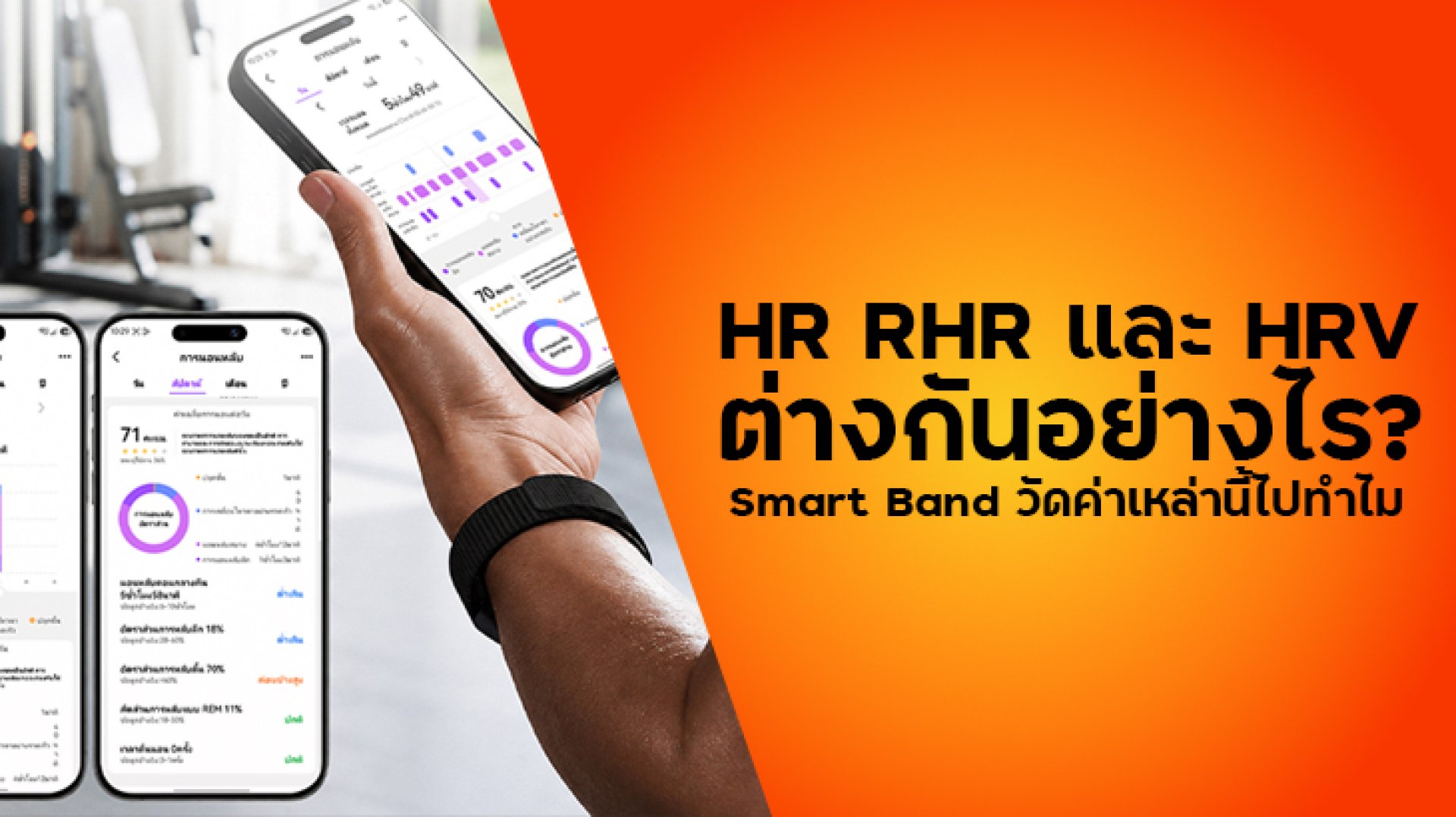
When it comes to health tracking with a Smart Band or Fitness Tracker, you may have seen terms such as HR, RHR, and HRV in the companion app. Although all three are related to heart activity, they do not mean the same thing.
HR (Heart Rate) refers to the number of times your heart beats within a specific period, while RHR (Resting Heart Rate) refers to your heart rate when your body is at rest. HRV (Heart Rate Variability) refers to the variation in the time intervals between individual heartbeats.
Therefore, a Smart Band that tracks HR, RHR, and HRV can provide a broader view of your daily health data, from physical activity and exercise to rest and recovery trends.
What Is HR?
HR, or Heart Rate, is the rate at which your heart beats. It is commonly expressed in beats per minute (BPM). Heart rate can change throughout the day depending on what you are doing, such as sitting, walking, running, or exercising, as well as other factors affecting the body and environment.
For example, when you exercise, your heart generally beats faster to help deliver blood and oxygen to your muscles. When you stop exercising and rest, your heart rate will generally decrease gradually.
Why Do Smart Bands Track HR?
Smart Bands can use sensors on the wrist to detect signals associated with heart activity and estimate heart rate. The collected information can then be displayed in a companion app, allowing users to monitor HR trends over different periods.
- Monitor heart rate throughout the day
- Track HR during exercise
- Observe changes in HR between rest and physical activity
- Review historical heart rate trends through the companion app
However, heart rate data from wearable devices should not be considered a replacement for medical examination or diagnosis. Measurements may also differ from those obtained using medical-grade equipment.
What Is RHR?
RHR, or Resting Heart Rate, refers to the rate at which your heart beats while your body is at rest. It is different from general HR because it specifically focuses on periods when the body is not performing strenuous physical activity.
RHR can change due to many factors, including physical activity levels, stress, sleep, illness, caffeine intake, and other individual circumstances. For this reason, looking at your RHR trend over time can be more useful than focusing on a single measurement.
Why Do Smart Bands Track RHR?
Tracking RHR over time gives users information that can be compared across multiple days or weeks.
For people who exercise regularly, RHR can be used as one of several data points when looking at overall rest and recovery. It can be considered alongside other information such as sleep, HRV, activity levels, and how the body feels each day.
It is important not to use RHR alone to determine whether someone is healthy or unhealthy because heart rate can be influenced by many different factors.
What Is HRV?
HRV, or Heart Rate Variability, refers to the variation in the time intervals between individual heartbeats. Unlike HR, HRV does not represent the number of heartbeats per minute.
A person's heart does not normally beat with perfectly identical intervals between every beat. HRV describes the differences between those intervals.
HRV data can be used to help understand aspects of the body's response and autonomic nervous system activity. However, HRV should be interpreted in context and together with other information rather than being used on its own to determine a person's health condition.
Why Are Athletes and Active People Interested in HRV?
One reason HRV receives attention among people who exercise is that it can be used as one of several metrics for monitoring recovery.
For example, by tracking HRV regularly, users can observe their personal HRV trends and consider them alongside sleep quality, fatigue, activity levels, and how they feel on a particular day.
This means you should not assume that higher HRV is always better or lower HRV is always worse. HRV varies between individuals and can change depending on circumstances.
What Is the Difference Between HR, RHR, and HRV?
| Metric | Full Name | What It Measures | What It Can Be Used to Track |
|---|---|---|---|
| HR | Heart Rate | Heartbeats per minute | Activity, exercise, and changes in heart rate throughout the day |
| RHR | Resting Heart Rate | Heart rate while the body is at rest | Heart rate trends during periods of rest |
| HRV | Heart Rate Variability | Variation in the time intervals between heartbeats | Trends that can provide additional information about recovery and the body's response |
HR, RHR, and HRV Explained in Simple Terms
You can think of heart monitoring like looking at information from a car:
- HR = how fast the engine is running right now
- RHR = the engine's idle speed when the car is stationary
- HRV = the differences in timing between individual heartbeats
These three metrics represent different types of information. However, when viewed together and tracked over time, they can provide a broader picture of changes in the body during everyday life.
How Do Smart Bands Measure HR, RHR, and HRV?
Many Smart Bands use optical sensors positioned against the skin around the wrist to detect changes in blood volume associated with heart activity. This technology is commonly known as PPG (Photoplethysmography).
The device collects sensor data and processes it using algorithms before displaying the results through a companion application.
For HR, the device can display an estimated heart rate. RHR focuses on measurements collected while the body is at rest, while HRV requires analysis of the timing between individual heartbeats to estimate heart rate variability.
Why Is It Better to Look at Trends Instead of a Single Measurement?
One of the advantages of a Smart Band is its ability to collect data continuously and present it as trends. This can be particularly useful for metrics such as HR, RHR, and HRV, which can change depending on activity and the body's condition.
For example, a person's HRV may change from one day to another. Looking at data collected over several days can make it easier to identify personal patterns than relying on a single measurement.
Therefore, the value of a Smart Band is not simply knowing "What is my number today?" but also being able to monitor health trends over time and consider them alongside sleep, exercise, and how you feel each day.
How Are HR, RHR, and HRV Related to Exercise?
For people who exercise regularly, heart-related data can help provide additional insight into how the body responds during activity and rest.
Before Exercise
Users can review baseline information such as RHR and HRV trends alongside how they feel and how well they slept. These data points can be used as part of the overall picture when planning activity for the day.
During Exercise
HR can be useful for monitoring how the heart responds to exercise intensity, particularly during activities such as running, cycling, and other forms of exercise.
After Exercise
HR and HRV data can be considered alongside sleep quality, fatigue, activity levels, and how the body feels to provide additional context about recovery.
Kieslect Biokoop Supports HR, RHR, and HRV Tracking
For users who want to monitor health data throughout the day, Kieslect Biokoop is a screenless health band designed for comfortable all-day wear. It supports multiple health tracking features through the Kstyle OS app.
Kieslect Biokoop supports tracking for HR, RHR, and HRV, as well as other metrics such as SpO, sleep, stress, mood, and fitness data. The device also supports 178 sports modes and GPS for location and workout route tracking.
Another notable feature is its screenless design. The device weighs approximately 12.7 grams without the strap and offers up to 21 days of battery life under the manufacturer's specified usage conditions.
Who Is a Smart Band with HR, RHR, and HRV Tracking Suitable For?
- People who want to monitor health-related trends in everyday life
- People who exercise and want to monitor HR during workouts
- Runners who want additional data to support their training
- People interested in monitoring sleep and recovery
- People looking for a lightweight device for continuous wear
- People who prefer not to wear a full-screen smartwatch all day
What Should You Know Before Using Smart Band Health Data?
Smart Band and Fitness Tracker data can be useful for monitoring trends and supporting everyday wellness, but it should not be used as a replacement for professional medical examination or diagnosis.
Measurement accuracy can be affected by several factors, including how the device is worn, sensor contact, strap tightness, movement, skin characteristics, and the type of activity being performed. Therefore, it is best to use the information as a trend and consider it in the context of your overall situation.
If you experience unusual symptoms or have concerns about your health, consult a qualified healthcare professional rather than relying solely on data from a Smart Band.
HR, RHR, and HRV: A Quick Summary
HR is your heart rate at a particular point in time. It can be useful for monitoring how the heart responds to activity and exercise.
RHR is your resting heart rate. It can be useful for monitoring heart rate trends while the body is at rest.
HRV refers to the variation in the time intervals between heartbeats. It can provide additional information that may be considered when monitoring recovery and the body's response.
When a Smart Band can track all three metrics, users can gain a broader view of their health data. The key is not to focus on a single number, but to monitor trends over time and consider them alongside sleep, exercise, and how the body feels each day.
FAQ: Frequently Asked Questions About HR, RHR, and HRV
What is the difference between HR and RHR?
HR is the heart rate at a particular point in time, while RHR is the heart rate measured while the body is at rest. Therefore, RHR can be considered a specific type of heart rate measurement focused on resting conditions.
Is HRV the same as heart rate?
No. HRV does not represent the number of heartbeats per minute. Instead, it refers to the variation in the time intervals between individual heartbeats.
Can a Smart Band measure HRV?
Some Smart Bands support HRV tracking using sensor data and device algorithms. However, the measurement methods and ways the results are presented can vary between brands and models.
Is a higher or lower HRV better?
You should not determine whether HRV is good or bad based on a single number. HRV varies between individuals and can change due to many factors. Monitoring your personal trend and considering it alongside other information can provide more useful context.
Why should I track HR, RHR, and HRV continuously?
These metrics can change depending on activity, rest, exercise, sleep, and other factors. Continuous tracking makes it easier to observe trends and personal patterns compared with taking a single measurement.