What Is Semiconductor Cooling? How It Works in Mobile Phone Coolers

What Is Semiconductor Cooling? Semiconductor Cooling is a cooling technology that uses semiconductor materials to transfer heat from one side of a device to the other when electrical current flows through it. Based on a phenomenon known as the Peltier Effect, this technology is used in various electronic cooling applications, including gaming phone coolers designed to help manage heat during demanding mobile gaming sessions.
Unlike a conventional fan that primarily moves air across a surface, a semiconductor-based cooling system can actively transfer heat through a dedicated cooling module. However, its effectiveness depends on the entire system design, including power consumption, heat dissipation, contact with the phone, and surrounding conditions. A cooler that uses this technology will not necessarily outperform every conventional cooling fan.
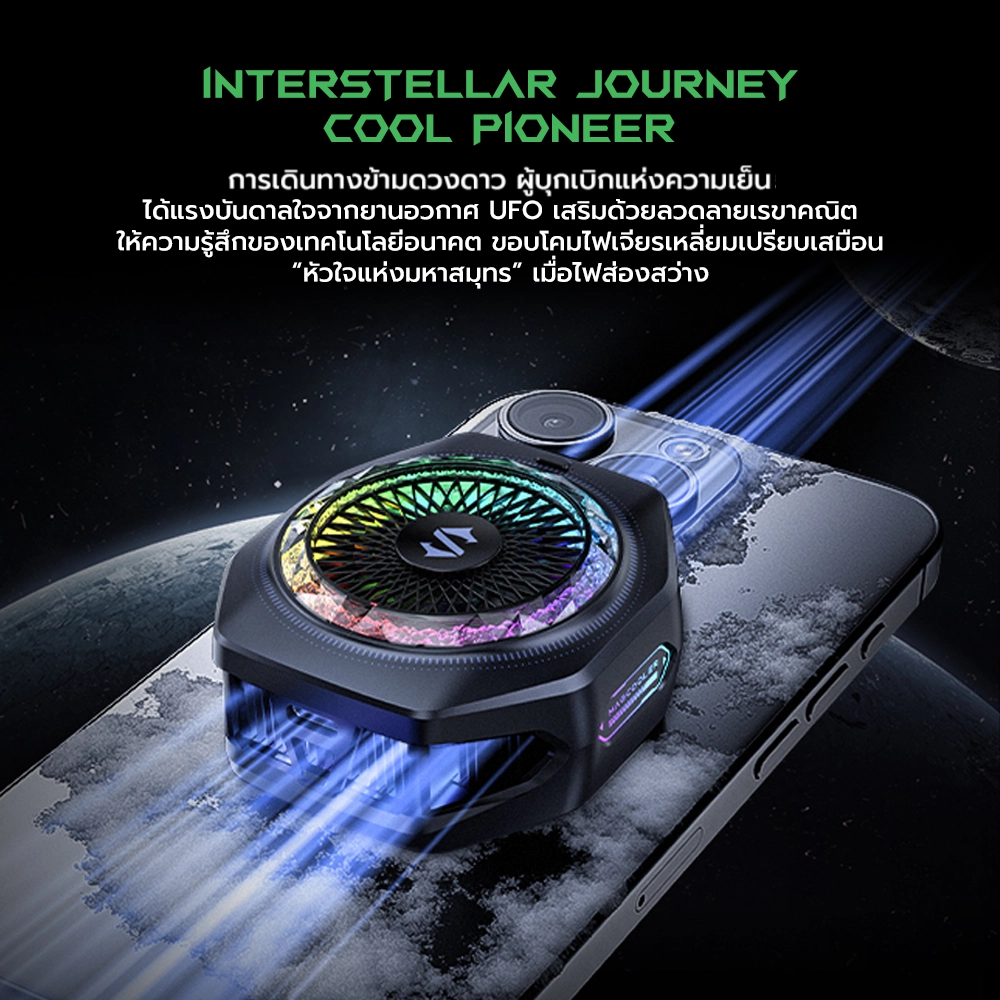
1. What Is Semiconductor Cooling and How Does It Work?
To understand What Is Semiconductor Cooling, it helps to start with the component at the heart of the technology: the Thermoelectric Cooler (TEC), also known as a Peltier module.
A typical TEC contains multiple pairs of semiconductor elements positioned between ceramic plates. When direct current (DC) passes through the module, heat is transferred from one surface to the other. One side becomes colder while the opposite side becomes hotter.
The cooling process can be explained in four basic steps:
- Electrical power is supplied: Direct current flows through the semiconductor elements inside the TEC module.
- Heat transfer begins: The module absorbs heat on one side and releases it on the other.
- The cold side contacts the device: In a phone cooler, this side is positioned against the back of the smartphone or an appropriate thermal contact surface.
- The hot side releases heat: A heat sink and fan help transfer heat from the hot side into the surrounding air.
The final step is essential. A TEC does not make heat disappear; it moves heat from one location to another. The hot side must dissipate both the heat removed from the phone and the additional heat generated by the module's electrical power consumption.
2. What Is the Peltier Effect?
The Peltier Effect is a thermoelectric phenomenon in which an electrical current passing through a junction between different materials causes heat to be absorbed or released. This effect provides the operating principle behind thermoelectric cooling modules.
In simple terms, a TEC uses electrical energy to move heat through semiconductor materials. This creates a cold side and a hot side, allowing the module to cool a specific surface when the system is designed and operated correctly.
This differs from a conventional cooling fan, which mainly increases airflow to carry heat away from surfaces. A TEC actively transfers heat through its module, but it still needs an effective heat sink and airflow system to remove that heat from the hot side.
You may see the terms Semiconductor Cooling, TEC Cooling, Peltier Cooling, and Thermoelectric Cooling used in product descriptions. They are closely related, but it is still important to check the manufacturer's specifications to confirm the cooling mechanism used in a particular product.
3. Semiconductor Cooling vs. Conventional Phone Cooling Fans
Not all mobile phone coolers use the same technology. Some rely on a fan and heat sink, while others combine a fan with a TEC module to transfer heat away from the phone's contact surface.
| Feature | Conventional Phone Cooler | Semiconductor Cooling System |
|---|---|---|
| Cooling principle | Uses airflow to help dissipate heat | Uses a TEC module to transfer heat from one side to the other |
| Dedicated cold plate | Usually does not include a TEC cold plate | Typically includes a cold surface when designed for direct-contact cooling |
| Power requirements | Primarily powers the fan | Powers the TEC module and usually a fan as well |
| System design | Generally simpler | Must manage both cold-side and hot-side temperatures |
| Potential limitation | Performance depends on airflow and ambient conditions | Power consumption and hot-side heat dissipation are important constraints |
| Best suited for | Users who want additional airflow and a straightforward cooling solution | Users who want active heat transfer and can accommodate the system's power requirements |
Neither approach is automatically better in every situation. Actual cooling performance depends on the complete design, including thermal contact, heat-sink capacity, airflow, power input, and the phone's own thermal architecture.
4. Why Is Semiconductor Cooling Useful for Mobile Gaming?
Demanding mobile games can place a sustained workload on a smartphone's processor and graphics hardware. As these components work harder, they generate heat. If temperatures become too high, the device may reduce performance to stay within its thermal limits. This behavior is commonly known as thermal throttling.
A phone cooler that uses semiconductor cooling can help draw heat away from the phone's exterior when its cold plate makes suitable thermal contact with the device. Under the right conditions, this may help manage heat buildup during extended gaming sessions.
Potential benefits include:
- Additional heat removal: The TEC module can transfer heat away from the contact surface.
- More consistent performance: Better thermal management may help reduce performance fluctuations when heat is the limiting factor.
- Support for extended gaming: Active cooling may be useful during long sessions involving demanding games.
- Supplementary cooling: The cooler can work alongside the phone's built-in thermal management system.
However, a lower external surface temperature does not guarantee an equivalent reduction in CPU or GPU temperature. It also does not guarantee a higher frame rate. The results depend on the phone model, game, workload, cooler design, and environmental conditions.
5. Advantages and Limitations of Semiconductor Cooling
Understanding the strengths and limitations of Semiconductor Cooling helps you decide whether a TEC-based phone cooler is suitable for your needs.
Advantages of Semiconductor Cooling
- Can create a cold surface: Under suitable operating conditions, the cold side can reach a temperature below the surrounding air temperature.
- Compact design: TEC modules can be integrated into relatively small electronic devices.
- No compressor required: Thermoelectric cooling does not require a compressor or the refrigerant cycle used by conventional vapor-compression systems.
- Electrical control: The cooling effect can be adjusted through the system's power and temperature-control design.
Limitations of Semiconductor Cooling
- Additional power consumption: The TEC module requires electrical power beyond what may be needed to operate a fan alone.
- Hot-side heat buildup: Insufficient heat dissipation can reduce cooling performance.
- Condensation risk: Moisture can form if a cold surface drops below the dew point of the surrounding air.
- Not a universal solution: It cannot resolve every source of heat or every performance limitation in a smartphone.
For these reasons, the best TEC-based cooler is not necessarily the one with the highest advertised wattage or the lowest claimed temperature. The overall thermal design matters more than any single specification.
6. Can Semiconductor Cooling Cause Condensation on a Phone?
Yes, condensation is possible. When the cold plate's surface temperature falls below the dew point of the surrounding air, moisture can condense into water droplets on the cold plate or nearby surfaces.
The likelihood depends on several factors, including:
- The temperature of the cooling plate.
- The humidity and temperature of the surrounding air.
- The cooler's temperature-control behavior.
- The design of the cooler and the way it contacts the phone.
Condensation is not inevitable with every semiconductor cooler. Different products use different temperature-control strategies and have different operating characteristics. Nevertheless, it is an important consideration when using a device that can create a surface significantly colder than the surrounding air.
Follow the cooler manufacturer's instructions, avoid using equipment in conditions outside its specified operating range, and stop using it if unexpected moisture appears near the phone or its accessories. Water and electronic components are a combination that should be treated cautiously.
7. How to Choose a Semiconductor Cooling Phone Cooler
If you are considering a TEC-based phone cooler, evaluate the complete system rather than relying on marketing terms alone.
Check the Cooling Technology
Look for clear specifications confirming that the product includes a Thermoelectric Cooler or Peltier module. Also check how the TEC works with the fan, heat sink, and contact plate. A product's name alone is not sufficient proof of its cooling architecture.
Evaluate the Hot-Side Heat Sink
The heat sink and fan must remove the heat released by the TEC's hot side. This includes the heat transferred from the phone and the electrical energy converted into heat during operation. If the hot side cannot dissipate heat effectively, overall cooling performance may suffer.
Check Power Requirements
Review the required voltage, power input, connector type, and recommended power source. If the cooler requires an external USB power supply, make sure the supply meets the manufacturer's specifications. Do not assume that every phone's USB port can provide enough power for every cooler.
Confirm Phone Compatibility
Check the cooler's dimensions, attachment method, and contact area. Consider whether your phone case interferes with the cooler's fit or thermal contact. A poorly fitted cooler may not transfer heat as effectively as intended.
Look for Temperature Control and Safety Features
Where available, review temperature-control functions and protection against excessive operating temperatures. Read the manufacturer's instructions regarding condensation, recommended usage conditions, and safe operation.
8. Who Should Consider Semiconductor Cooling?
A semiconductor-based phone cooler may be worth considering if you regularly play graphically demanding games, stream gameplay, or experience sustained heat buildup during extended sessions.
It may be less necessary if you mainly use your phone for everyday tasks, play games for short periods, or already have adequate thermal performance from the phone's built-in cooling system. A conventional fan-based cooler may be sufficient for some users who simply want additional airflow.
Start by identifying the problem you want to solve. For example, determine whether the phone becomes uncomfortably warm, whether performance drops during long sessions, or whether the device's temperature is already well controlled. Choosing an accessory based on a real need is more useful than selecting one solely because it advertises a particular cooling technology.
Frequently Asked Questions About Semiconductor Cooling
Is Semiconductor Cooling the same as TEC Cooling?
In the context of electronic cooling, the terms often refer to the same general thermoelectric technology. TEC stands for Thermoelectric Cooler, while Semiconductor Cooling describes the technology more broadly. Check the product specifications to confirm whether a particular device actually uses a TEC module.
Is Semiconductor Cooling better than a conventional phone cooler?
Not in every situation. A TEC module can actively transfer heat through a cooling plate, but it requires electrical power and effective hot-side heat dissipation. A conventional fan-based cooler is generally simpler. Compare real-world performance, compatibility, and power requirements before choosing.
Can Semiconductor Cooling increase FPS?
It may help maintain more consistent performance if heat is causing the phone to reduce its processing speed. However, it cannot guarantee higher FPS because performance also depends on the processor, game optimization, graphics settings, and other device limitations.
Does Semiconductor Cooling consume more power than a regular phone fan?
A TEC-based cooler generally requires additional power for the thermoelectric module as well as the fan. Actual consumption depends on the product, its operating mode, and its design. Check the manufacturer's rated power requirements.
Can Semiconductor Cooling create water droplets on a smartphone?
Yes, condensation can occur if the cooling surface falls below the surrounding air's dew point. The risk depends on temperature, humidity, and the cooler's design. Follow the manufacturer's instructions and stop using the device if unexpected moisture appears.
Conclusion
Semiconductor Cooling is a thermoelectric technology that uses the Peltier Effect to transfer heat through semiconductor materials. By creating a cold side and a hot side, a TEC module can help draw heat away from a smartphone or another electronic device when integrated into a properly designed cooling system.
For mobile gamers, this technology offers another way to manage heat during demanding sessions. However, it does not automatically guarantee lower processor temperatures, higher FPS, or better performance than every conventional phone cooler. Consider the full cooling design, power requirements, phone compatibility, and condensation risk before choosing a device.